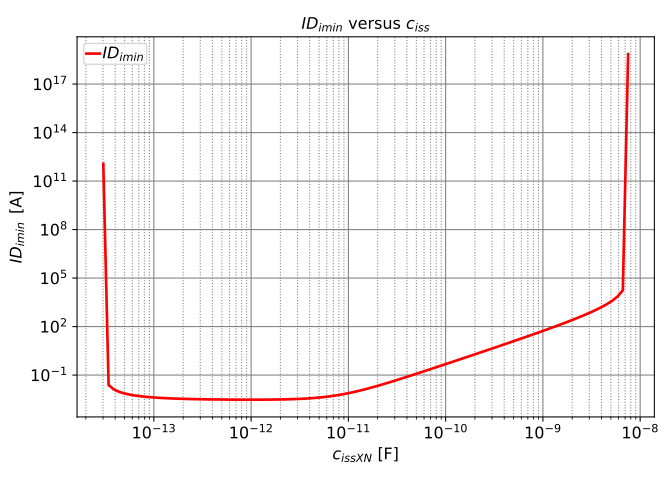
For a given current the maximum $g_m$ occurs as $IC$ approaches 0 so I have:
\begin{equation} g_{m max}=25.05 ID_{i}\,\left[ \mathrm{\mathtt{\text{S}}}\right] \end{equation}I can solve for $ID$:
\begin{equation} ID_{i min}=0.03992 g_{m max}\,\left[ \mathrm{A}\right] \end{equation}Now if I replace $g_{m_{max}}$ here for $g_m(c_{iss})$ I can find the minimum drain current required for a given $c_{iss}$
\begin{equation} ID_{i min}=\frac{c_{iss XN} \left(- 2.486 \cdot 10^{105} c_{iss XN}^{2} - 1.528 \cdot 10^{83}\right)}{7.079 \cdot 10^{93} c_{iss XN}^{2} - 5.324 \cdot 10^{85} c_{iss XN} + 1.608 \cdot 10^{72}}\,\left[ \mathrm{A}\right] \end{equation}The maximum transit frequency occurs in strong inversion when $IC\gg IC_{CRIT}$. In this region the transit frequency can be modeled with only $L_i$ (Binkley pg. 181)
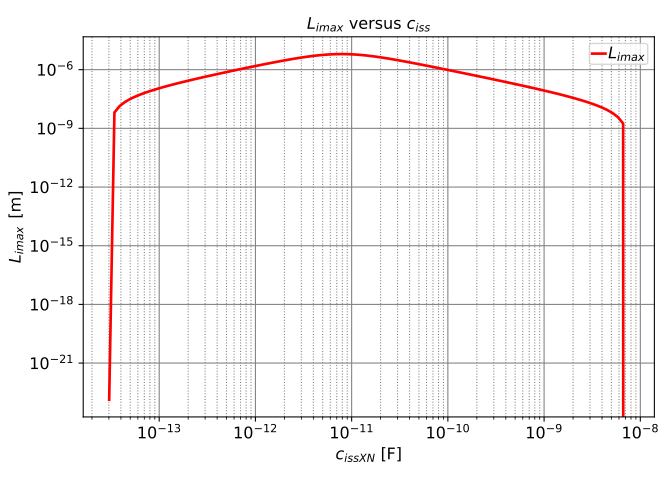
\begin{equation} f_{T max}=\frac{0.25 E_{CRIT N18} u_{0 N18}}{\pi L \left(N_{s N18} - 0.3333\right)}\,\left[ \mathrm{Hz}\right] \end{equation}This means I have a function for $L_{i_{max}}$ that varies for f_T and I can write that as a function of $c_iss$
\begin{equation} L_{i max}=\frac{E_{CRIT N18} u_{0 N18} \cdot \left(4.418 \cdot 10^{79} c_{iss XN}^{2} - 3.323 \cdot 10^{71} c_{iss XN} + 1.004 \cdot 10^{58}\right)}{\left(4 N_{s N18} - 1.333\right) \left(- 1.943 \cdot 10^{92} c_{iss XN}^{2} - 1.195 \cdot 10^{70}\right)}\,\left[ \mathrm{m}\right] \end{equation}
Go to Balanced-Cross-Coupled-MOSFET-Noisy-Nullor-Analysis_index
SLiCAP: Symbolic Linear Circuit Analysis Program, Version 2.0.1 © 2009-2023 SLiCAP development team
For documentation, examples, support, updates and courses please visit: analog-electronics.tudelft.nl
Last project update: 2023-11-25 20:52:48